
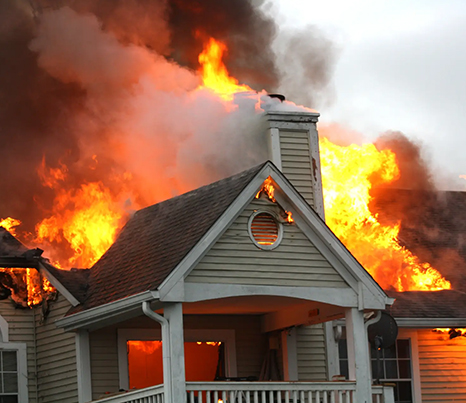
You put out the fire. The smoke cleared. The firefighters packed up and left. And now you’re standing in a house that smells like a campfire and wondering what exactly happens next.
Here’s the part most homeowners don’t expect: the fire being out doesn’t mean the damage stopped. In fact, some of the most destructive processes kick in after the flames are gone. The culprits are two things that seem unrelated at first glance: soot and humidity. Together, they create a chemical reaction that quietly destroys surfaces, poisons air quality, and turns a recoverable situation into a much bigger problem.
Understanding what’s actually happening inside your home after a fire helps you make smarter decisions fast. So let’s break it down in plain terms.
What Soot Actually Is
Most people think of soot as a coating, like ash you can wipe away. It’s actually more complicated than that.
Soot is a byproduct of incomplete combustion. When materials burn without enough oxygen to fully combust, they release a mix of carbon particles, acids, chemicals, and heavy metals. What’s in the soot depends on what burned. Synthetic materials like carpet, upholstery, and plastics produce some of the most chemically aggressive residue. Wood produces a drier, more powdery soot. Cooking fires leave a greasy, sticky film. Each type behaves differently on surfaces and requires a different approach to remove safely.
The particles themselves are tiny. Far smaller than what you can see, they penetrate porous materials like drywall, wood, insulation, and fabric. They settle into HVAC systems and get recirculated through the home. They embed in grout lines, ceiling texture, and the tiny gaps around trim. This is why you can’t simply wipe down the walls and call it done.
Soot is also acidic. Within hours of a fire, that acidity starts reacting with metal fixtures, appliances, and even painted surfaces. Chrome pitting, copper tarnishing, and paint breakdown are all common results. The longer soot sits, the more aggressive that corrosion becomes. A 24-hour delay can mean the difference between cleaning a surface and having to replace it entirely.
Where Humidity Enters the Picture
Now add water to the equation, and things get more complicated.
Firefighting efforts introduce a significant amount of moisture into a structure. Hundreds of gallons can soak into flooring, walls, insulation, and subfloor materials during an active suppression effort. Even smaller fires that were extinguished quickly often leave behind more moisture than homeowners realize.
Once that moisture is inside your walls and floors, it raises the relative humidity throughout the home. That humidity doesn’t just sit there. It interacts with everything around it, including the soot that has already settled on and into your surfaces.
Humidity accelerates the chemical reactions that soot triggers. It makes acidic residue more mobile, allowing it to penetrate deeper into porous materials. It activates compounds in the soot that were otherwise stable when dry. It softens the bond between smoke particles and surface coatings, which sounds helpful but actually makes improper cleaning attempts more likely to smear residue deeper rather than lift it off.
And then there’s the biological side of it. Mold needs three things: a food source, the right temperature, and moisture. Soot-covered drywall and wood give mold plenty to feed on. Your home’s normal indoor temperature is ideal. Add firefighting moisture, and mold colonies can establish within 24 to 48 hours in affected areas, sometimes in spaces you can’t see until the damage is already significant.
The Hidden Damage in Rooms That Look Fine
One of the biggest surprises homeowners face after a fire is discovering damage in rooms where nothing burned.
Smoke is lighter than air during a fire and rises fast, but as it cools it travels laterally through any available pathway. HVAC systems are particularly efficient at distributing smoke and soot particles throughout a home. Rooms on the opposite side of the house, upstairs bedrooms, and finished basements can all accumulate residue simply because air moved through the ductwork during and after the event.
Humidity follows the same pathways. Moisture introduced by firefighting migrates through wall cavities, under flooring, and into adjacent spaces over time. The visible damage tells you where the fire started. It doesn’t tell you where the aftermath ended up.
This is also why air quality after a fire is a real concern even in areas that look untouched. Volatile organic compounds released by burning materials, combined with the fine particle content of soot, create indoor air quality problems that linger well beyond what you can smell. The odor fading doesn’t mean the compounds are gone.
Why Timing Changes Everything
The chemistry of fire damage is time-sensitive in a way that’s worth taking seriously.
In the first few hours, soot is still mostly surface-level on many materials. Acids are beginning to react but haven’t penetrated deeply yet. Moisture is present but hasn’t fully migrated into wall cavities. Professional intervention at this stage preserves the most material and keeps restoration costs lower.
By 24 to 48 hours, the picture changes. Corrosion accelerates on metals. Soot particles embed more deeply into porous surfaces. Mold begins establishing in wet areas. Odor compounds bind more tightly to structural materials, making deodorization harder.
By the end of the first week without proper treatment, materials that could have been cleaned often need to be replaced. Subfloor damage that might have been addressed with targeted drying now extends further. The scope of the job, and the cost of it, grows with every day that passes.
This isn’t meant to create panic. It’s meant to give you a realistic picture of why “we’ll deal with it after the weekend” tends to be an expensive decision.
What Proper Restoration Actually Addresses
Given all of this, effective fire damage restoration has to do more than make things look clean. It has to address the chemistry.
That means removing soot using methods matched to the residue type and surface material, not a one-size-fits-all wipedown. It means extracting moisture and using professional drying equipment to bring structural materials back to safe moisture levels before repairs begin. It means treating odor at its source by neutralizing compounds in framing, insulation, and other porous materials, not just masking them at the surface level. And it means documenting the full scope of damage, including what’s hidden inside walls and floors, so nothing gets rebuilt over a problem that hasn’t been solved.
Each of those steps depends on the ones before it. Repainting over soot locks in odor and allows corrosion to continue. Rebuilding over wet framing creates ideal conditions for mold. The sequence isn’t arbitrary. It reflects the chemistry involved.
Turn to the Pros
If you’re reading this after a fire, you’re already doing something right. Understanding what’s happening in your home puts you in a better position to ask the right questions and make decisions that protect your investment.
GoDry Chicago works with homeowners throughout the Chicago area to handle fire damage restoration from stabilization through final repairs. If you have questions about your specific situation or want to understand the scope of what you’re dealing with, reaching out costs nothing. A conversation about what you’re seeing is always a good place to start.